

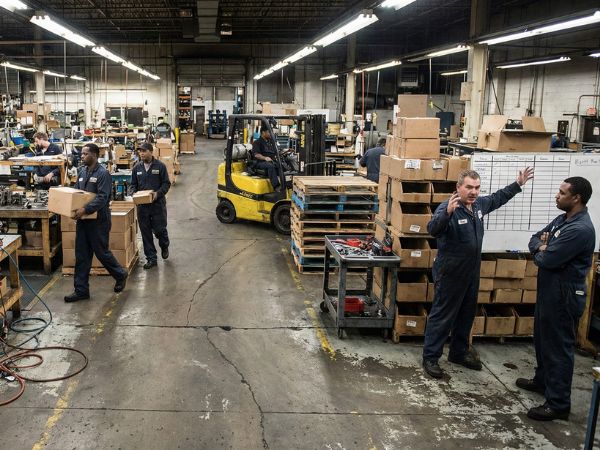
It’s not always the big issues that cause the biggest bottlenecks. Sometimes, it’s the simple things, like where a component is stored, how far an operator has to walk to fetch it, or how smoothly parts flow from one station to the next.
Manual assembly areas are especially vulnerable to layout inefficiencies. Without real-time data and automated guidance, it’s easy for time, energy, and productivity to get lost in motion.
We’ve seen how small tweaks in layout can have a huge impact on output. And when paired with smart automation, the right layout can turn a sluggish manual line into a lean, efficient operation.
The Cost of a Poor Layout
If your team is spending more time walking between bins than assembling parts, it’s a sign that the layout needs attention. And it doesn’t take much to throw things off.
Here’s what we typically see on manual lines:
- Operators walking long distances to retrieve components
- Shared tools or test equipment slowing down the pace
- Sub-assemblies piling up due to poor flow
- Ergonomic strain from awkward or repetitive movement
- Bottlenecks forming at inspection or test stations
These issues often don’t show up in reports, but they show up in output. In lost minutes, tired staff, inconsistent cycle times, and higher part costs.
Smart Layout = Better Throughput
A well-optimised assembly layout supports smooth material flow, reduces unnecessary motion, and keeps operators focused on value-added tasks.
It’s not just about convenience, it’s about throughput, quality, and safety.
We help manufacturers move beyond “that’s how it’s always been” and build lines that are designed around real efficiency.
- Ergonomic Design That Works for People
Manual assembly can be physically demanding, especially if the workstations weren’t designed with ergonomics in mind. Poor posture, excessive reaching, and repetitive motion all contribute to fatigue, injury risk, and slower work.
Our team looks at the human element just as closely as the process. We design workstations that:
- Keep key components within easy reach
- Use height-adjustable benches or fixtures
- Integrate lift-assist or rotation tools
- Reduce unnecessary bending, walking, or twisting
The result? Operators are more comfortable, more productive, and less likely to make errors caused by fatigue.
- Minimising Movement and Maximising Flow
When operators have to walk to another station or search for parts, you’re paying for time that doesn’t add value.
We work with you to analyse your line layout and identify ways to reduce non-value-added motion. That could mean:
- Introducing point-of-use component bins
- Reconfiguring line-side racking
- Adding automated part delivery systems
- Integrating material flow conveyors or buffers
Even a few seconds saved per cycle can have a major impact across an entire shift or production week.
- Better Line Balancing and Sub-Assembly Flow
A disorganised sub-assembly process can cause real headaches. If upstream stations are out of sync with downstream ones, you get WIP (Work In Progress) stacking up, missed deliveries, or wasted waiting time.
Our systems help rebalance manual and automated processes to support smoother flow. Whether through automation, better layout design, or buffer control, we make sure each part of the process feeds the next at a consistent rate.
We can also integrate automated part presentation and delivery into our assembly and test systems, ensuring that the right part is in the right place, exactly when it’s needed.
- Combining Layout Improvements with Automation
While layout changes can significantly boost efficiency, combining them with automation delivers even bigger gains.
For example, replacing a manually loaded test station with an ALPHR automated solution not only speeds up the test itself, but also:
- Eliminates walking time to and from the station
- Removes the need for manual data entry
- Standardises cycle times and improves throughput
We don’t just drop in a machine, we help re-engineer the surrounding space to make sure everything flows together seamlessly.
What You Can Expect from an Optimised Layout
When you streamline your manual assembly area with smart layout design and automation, you’ll see results that matter:
- Shorter cycle times
- More consistent output
- Less operator fatigue
- Improved safety and ergonomics
- Better use of floor space
- Higher overall efficiency
And you don’t need a full system overhaul to get started. Even small improvements in workstation layout or material handling can create measurable impact, and we’re here to help you find them.
Let’s Design a Smarter Space for Your Team
If your assembly area feels more like a maze than a manufacturing line, it’s time to rethink the layout.
At ALPHR, we combine deep experience in automation, lean thinking, and ergonomic design to help you optimise your manual operations, making them faster, safer, and more cost-effective.
Let’s work together to turn wasted steps into measurable gains. Get in touch to review your layout and discover how small changes can drive big results.