

Few things are more frustrating for a plant manager than watching a fully assembled, high-value product fail its final End-of-Line (EoL) test. By that point, the unit has passed through every single station on your floor. It has consumed valuable components, absorbed hours of operator labour, and taken up critical machine cycle time. Discovering a fatal defect at the very end of the journey means all that added value is instantly transformed into expensive scrap or timely rework.
Yet, many high-volume production facilities still suffer from a distinct lack of inspection throughout the assembly process. They treat quality control like an event that happens at the finish line, rather than a continuous discipline embedded into every step of manufacture.
To build a truly resilient, cost-effective production line, the mindset must shift from merely catching failures to actively preventing them from advancing.
The Compounding Cost of Blind Assembly
When a manufacturing process lacks intermediate inspection, a small error made at station one remains completely invisible until the final test cell.
Consider a Tier 1 automotive infotainment module. If an internal circuit board is misaligned or a delicate connector is pinched during the initial housing assembly, the product is functionally dead from the start. However, without real-time validation, the line keeps moving. The system blindly adds expensive displays, premium trim pieces, and final software flashes to a unit that is already broken.
By hiding the defect until the EoL stage, you aren’t just losing a cheap component; you are throwing away the total accumulated value of the entire build.
Introducing Real-Time Checks and Balances
The fix to this compounding waste is the strategic integration of in-line verification. This means introducing targeted, real-time checks at critical assembly milestones before the product is permitted to move forward.
These balances do not need to slow down your cycle times. Modern automation allows for seamless, high-speed inspections to be conducted in parallel with assembly tasks.
- Vision Systems: Verifying component presence, orientation, and correct colour coding in milliseconds.
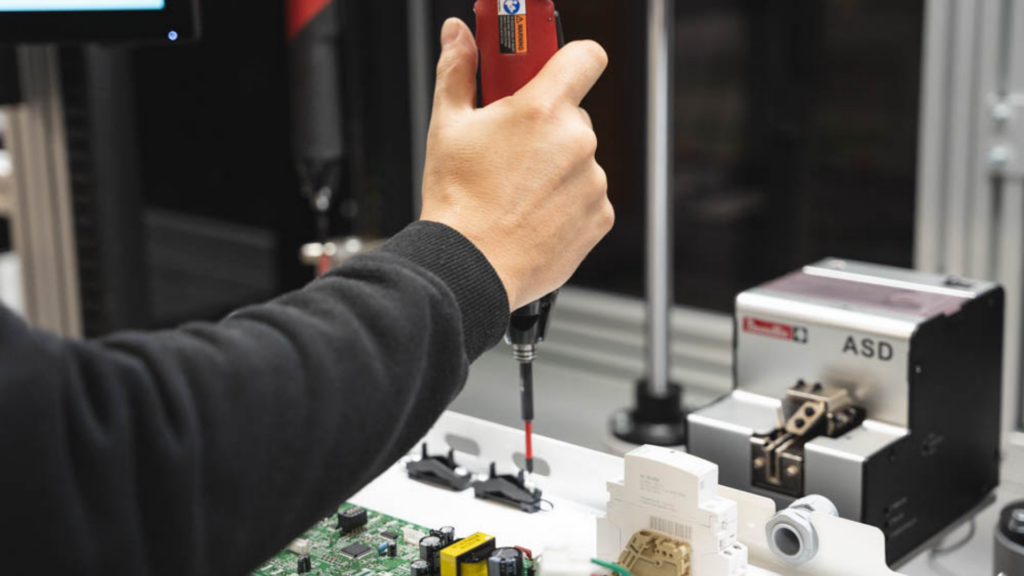
- Smart Tooling: Utilising torque-controlled screwdrivers to immediately flag a stripped thread or a missed fastening.
- Sensors: Conducting quick electronic or pneumatic continuity checks right after a connection is made.
By implementing these checkpoints, you transform your assembly line into a series of mini quality gates, ensuring that every sub-assembly is certified perfect before it receives further investment.
The Operational Yield of In-Line Integrity
When you intercept a process failure the exact moment it occurs, the dynamics of your factory floor change dramatically.
Instead of an operator spending hours diagnosing a complex, fully sealed unit at a rework station, a faulty component can be swapped out instantly at the source. Scrap rates plummet because errors are corrected before they become permanent.
Furthermore, your final EoL testing cells are freed up to do what they do best: validating a premium, functional product rather than acting as a chaotic sorting filter for assembly mistakes. This predictable flow optimises your overall equipment effectiveness (OEE) and keeps your output completely aligned with demanding customer schedules.
Cultivating a No-Faults Forward Culture
Transitioning away from downstream testing risks requires an automation partner who understands how to weave quality directly into the mechanical and digital fabric of your line.
At ALPHR Technology, our systems are engineered so that a product literally cannot progress to the next manufacturing step unless the current stage passes its real-time checks. If a screw isn’t torqued correctly or a component is missing, the line pauses or safely flags the unit right there.
We help you protect your margins by ensuring that you only add value to products that are guaranteed to pass. Let’s collaborate to integrate intelligent, real-time inspection into your next assembly roadmap.