

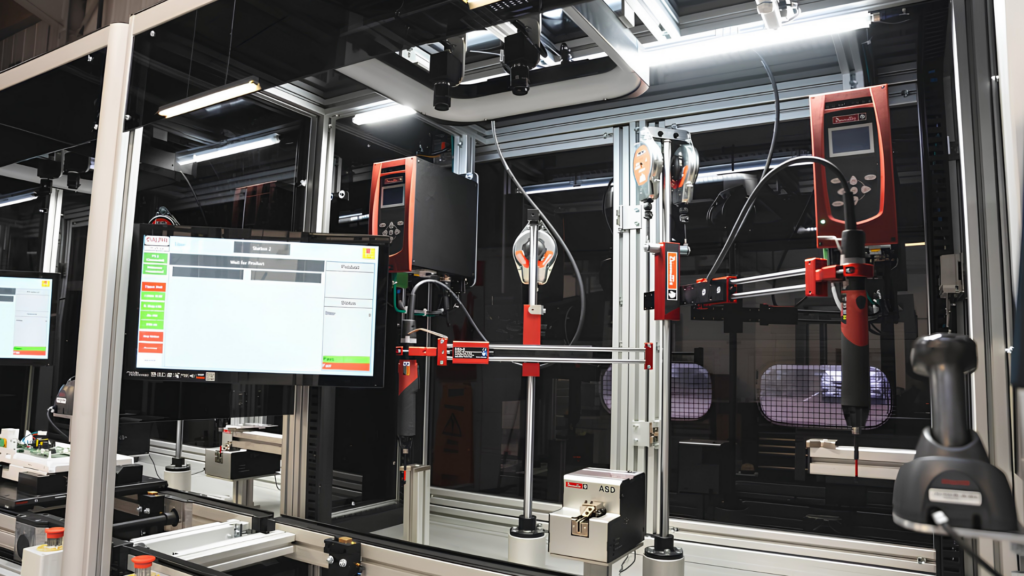
Automated assembly stops misalignment and torque failures by checking every step as it happens. A vision system confirms each part is present and in position before fastening starts, the screwdriving system records the torque and angle of every screw, and any part that fails is held at that station. ALPHR Technology builds assembly cells around these checks.
Both faults are expensive because they tend to be found late. A part sitting a fraction off-centre, or a screw that has cross-threaded, can look fine to the eye. It travels down the line collecting more parts and more labour, and turns up at end-of-line test or at your customer. By then you’re reworking a finished assembly over a single screw.
What causes misalignment and torque failures in manual assembly?
Mostly variation. Operators tire over a shift, fixtures wear, and screws vary from one batch to the next. A hand-held driver set to the right torque will still stop happily on a screw that has bottomed out on a cross-thread, because all it knows is that it reached torque. None of this is dramatic on its own. On a high-volume line it adds up to steady scrap and rework that’s hard to trace to a cause.
How does automated screwdriving verify torque?
An automated screwdriving system monitors each fastening while it happens. It measures the final torque and the angle the screw turned through, and checks both against limits set for that joint. A screw that reaches torque too early, usually a cross-thread or a burr, or turns too far, often a stripped thread or a missing part, falls outside those limits and is rejected on the spot.
We integrate screwdriving at every level of automation. At one end, an operator uses a screwdriver supplied by an automatic screw feeder. At the other, fully automatic screwdriving runs on XYZ Cartesian, SCARA or 6-axis robots. The right choice depends on your cycle time, the number of fastenings and how often the product changes.
How does vision stop misaligned parts?
Before the next operation starts, cameras check that each part is there, sits in the right place and measures within tolerance. If a component is missing, rotated or out of tolerance, the cell stops that cycle before a screw goes in. A loose part that’s caught is a quick fix. One that’s been fastened in the wrong place usually means a strip-down.
What happens to a part that fails a check?
It goes no further. Every ALPHR machine is designed around a principle we call No Faults Forward: each step in the assembly and test sequence must pass before the product is released to the next one. A failed fastening or a misaligned part is held where the fault happened, so the rework is small and the cause is obvious.
How do you trace recurring torque problems to a cause?
Through the data. Our machines include a statistical process control (SPC) data collection package that logs every fastening and inspection result against the part. When rejects start to cluster on one station or one batch of screws, you’ll see it in the trend before it becomes a quality escape.
What does this look like on a real line?
For an automotive supplier assembling moulded plastic spigots, ALPHR built a rotary assembly machine around a SCARA robot and an integrated vision system. One operator loads the parts. The machine assembles, inspects and tests each spigot and sorts it into a pass or fail bin, producing a finished part every 20 seconds.
Frequently asked questions
What is torque and angle monitoring?
Torque and angle monitoring checks each fastening against two limits: the final torque the screw reached and how far it rotated to get there. Checking both catches faults a torque-only driver misses, including cross-threading, stripped threads and missing parts.
What is No Faults Forward?
No Faults Forward is ALPHR Technology’s design principle for assembly and test machines. A product can only move to the next step once the current step has passed, so faults are caught and held at the station where they occur.
What levels of screwdriving automation does ALPHR offer?
ALPHR builds everything from manual screwdriving stations supplied by automatic screw feeders to fully automatic screwdriving on XYZ Cartesian, SCARA and 6-axis robots, often combined with vision for part presence, measurement and gauging.
If torque or alignment rejects come up in every quality meeting, talk to ALPHR about which checks your line is missing and where they should sit.