

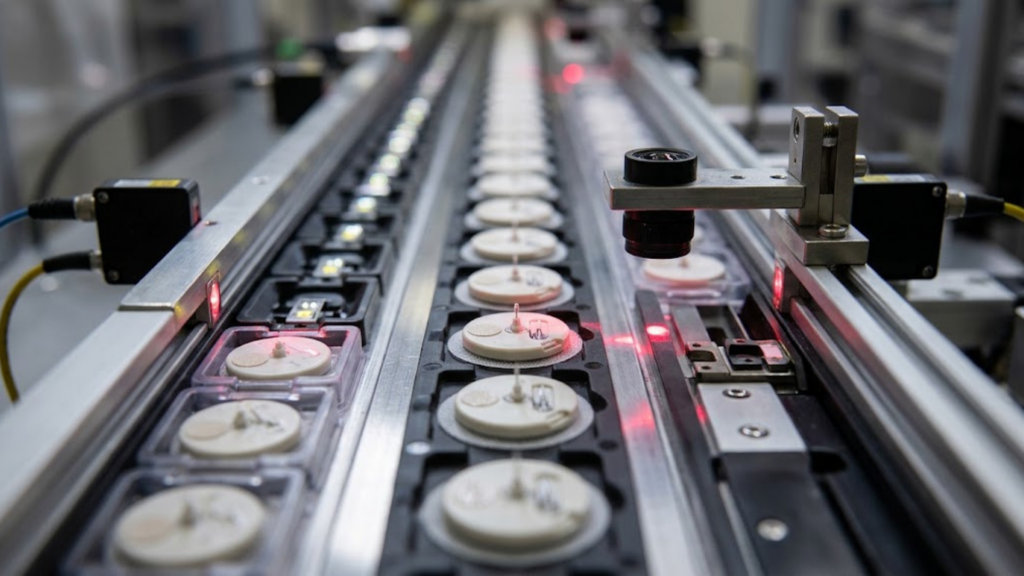
You can automate medical device assembly without adding regulatory risk if the automation is planned around your validation from day one. ALPHR Technology builds assembly and test cells for medtech manufacturers. The cells put devices together and prove they work; they don’t manufacture the components that go into the body, which keeps the scope of each validation clear.
That matters because regulation, more than cost, is what usually stops medtech plants from automating. Operations managers worry that a new custom cell will mean re-validating the whole process. So manual lines stay in place because they’re already validated, and the plant adds people to every bottleneck while labour costs rise and margins fall.
Does automating an assembly step mean re-validating the whole process?
Usually not. ISO 13485 requires you to validate any process whose output can’t be fully verified afterwards, and that includes automated assembly and test equipment and the software that runs it. For a new cell, that normally means installation, operational and performance qualification (IQ, OQ and PQ) of the cell itself. A cell with clearly defined inputs and outputs changes one part of your process, so change control and revalidation can focus on that part.
What should you ask an automation supplier for?
Before you sign, ask for a functional specification your quality team can test against, factory and site acceptance tests (FAT and SAT) that map to that specification, and documentation that supports your IQ and OQ protocols. If a supplier can’t describe these at the quotation stage, validation will cost you more than it should. We design each cell with your validation plan in mind and agree these documents at the start of the project.
Why does it matter which parts of the device the cell handles?
The strictest requirements sit with the parts that go into the body. Our medtech work is assembly and test: putting casings, electronics and sub-assemblies together and proving the finished device works. We don’t manufacture implanted or inserted components, and that boundary keeps each project’s scope, and your validation effort, easy to define.
What does this look like in practice?
ALPHR has built production lines for continuous glucose monitoring (CGM) devices, which have to be assembled with high precision at high speed. Our cells handle automated assembly and testing of the device casing and electronics; the sensor needle is made elsewhere. Each line we build leaves fewer unknowns for the next medical project, which shortens the time from specification to production.
What does automotive experience bring to medtech?
Automotive suppliers work to zero-defect targets at high volume, and we’ve spent 30 years building assembly and test machines for them. The habits carry straight over. Every step is checked, every result is stored against the part’s serial number, and a part that fails is stopped where it failed. In a medtech plant, that record is also the evidence an auditor will ask to see.
Frequently asked questions
Does an automated assembly cell need its own validation?
Yes. Under ISO 13485, a process whose output isn’t fully verified afterwards must be validated, and that includes automated assembly and test equipment and its software. This is usually done through IQ, OQ and PQ.
Is an automated assembly machine a medical device?
No. Production equipment isn’t a medical device, but it’s part of your controlled manufacturing process, so it falls under your quality management system and has to be validated before use.
Does ALPHR manufacture medical device components?
No. ALPHR Technology builds the equipment that assembles and tests medical devices, such as continuous glucose monitors. It doesn’t manufacture components that are implanted or inserted into the body.
If manual assembly is holding back a medtech product you want to scale, talk to ALPHR about which steps to automate first and what validating them would involve.