
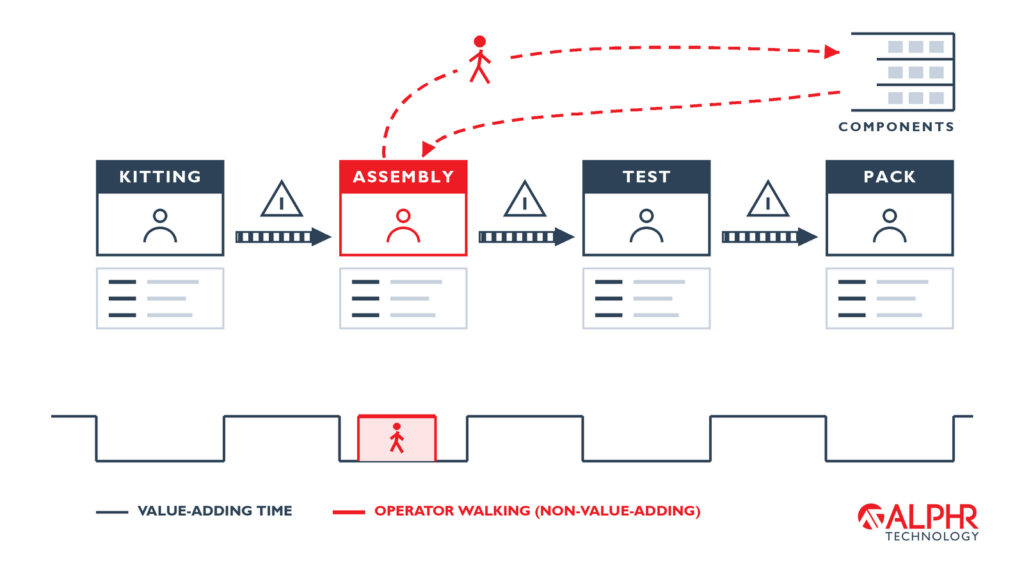
Have you ever calculated exactly how much time your operators spend walking away from their stations just to fetch components? While a few extra steps across the factory floor might not seem like a massive issue in isolation, multiplying that walking time across an entire shift results in a severe drain on your overall productivity.
Rethinking the Assembly Cell
The solution is not to simply ask your staff to move faster; it is to fundamentally redesign how parts flow through your facility. Creating your own automation roadmap starts by value stream mapping your current manufacturing processes, taking particular care on the interfaces between each distinct process. You need to carefully think how the production parts might flow through the process to simplify the tasks.
If you are running a high-volume manufacturing facility, forcing your team to constantly navigate a crowded assembly area creates bottlenecks and introduces unnecessary physical strain. By automating part or all of a process, you can improve workplace health and safety by reducing physical stresses and strains, and repetitive work.
Shrinking the Manufacturing Footprint
One of the most effective ways to reduce wasted operator movement is to condense the physical footprint of your production line. We are experts in advanced automation and in most cases, we can consolidate specifications down to a smaller number of machines than initially requested, optimising the setup and improving efficiency.
Bringing the Parts to the Process
Rather than operators walking to the parts, a truly modern facility ensures the parts come directly to the process. We believe that emerging technologies such as laser, laser diode, LiDAR, smart factory, augmented reality and 3D printing, offer real gains to our customers, when integrated into a production environment.
When it comes to fully autonomous vehicles/automated guided vehicles (AGVs) and cobots, ALPHR has a relationship with key original equipment manufacturers who provide this industry leading technology. This enables us to integrate these Industry 4.0 enablers into our control systems. By combining these automated delivery systems with our comprehensive test solutions, the entire operation becomes highly concentrated. The machine does the heavy lifting, and your operators can stay focused on the assembly process directly in front of them.
Freeing Up Your Team for Higher Value Tasks
Ultimately, an operator’s primary focus should be on tasks that add tangible value to the product, not on logistics and transport. An automation machine can be the equivalent of two or three staff, which enables the re-allocation of staff from dull and repetitive work to higher value-added tasks.
Automation provides fixed costs, where inflation has no impact, and there are controlled and forecastable labour and training requirements. Through careful value stream mapping and the introduction of smart factory principles, your production output becomes highly predictable, meaning production can be flexed to produce what you need when you need it. By embracing modular, consolidated automation, you eradicate the wasted time hidden in daily footsteps, protect your workforce, and build a far more agile manufacturing operation.