

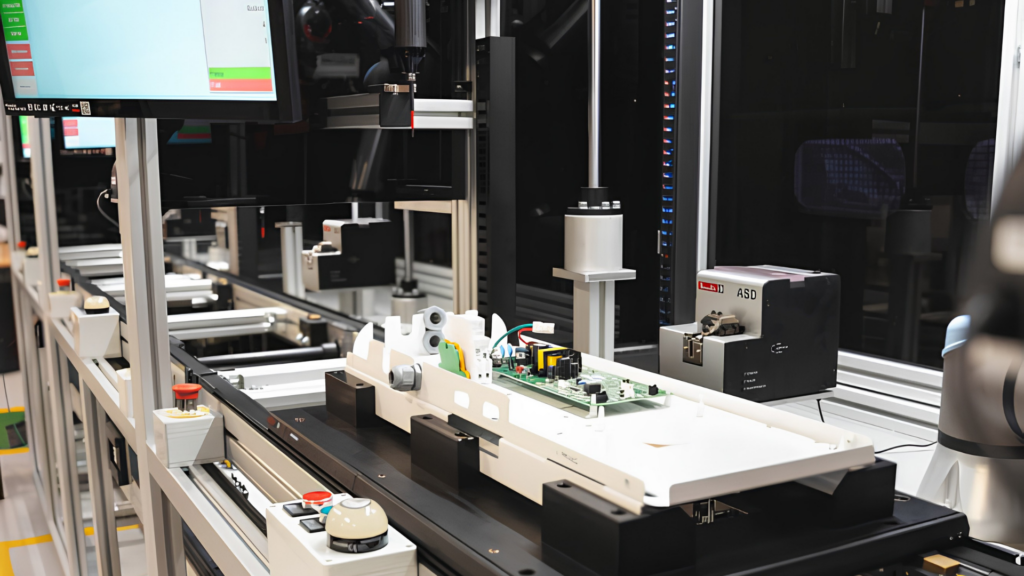
Predictive maintenance stops surprise breakdowns by monitoring how each machine behaves and flagging a component that’s starting to wear before it fails. The repair is then planned into a changeover. ALPHR Technology builds self-diagnosing assembly and test cells that work this way.
On a HVAC line, the stations that hurt most when they stop are the ones every unit passes through, such as compressor and heat exchanger handling or end-of-line leak and electrical testing. When one of those cells stops without warning, the line backs up behind it, operators stand idle, and shipments to distributors slip.
Why isn’t scheduled maintenance enough?
Calendar-based maintenance beats waiting for failure, but it works on averages. Some parts are replaced while they still have plenty of life left. Others wear faster than expected, because of a material variation or a change in operating conditions, and fail between services. Predictive maintenance replaces the calendar with the machine’s actual condition.
How does a self-diagnosing cell know a part is wearing?
It learns what normal looks like. Our cells capture data from sensors, drives and instruments over long periods of operation, and machine learning turns that history into a baseline for each cell. When a reading drifts from the baseline, the cell flags it. On a HVAC line, that might be a servo on a compressor transfer station drawing slightly more current than usual, or a clamp on a leak-test fixture taking a few milliseconds longer to close. Neither has stopped the machine yet, and both are quick to fix in a planned stop.
Why does machine design matter for maintenance?
Because a flagged part still has to be changed quickly. We build our cells from standardised, modular components, so a worn unit can be swapped without a bespoke strip-down and the spare parts list stays short. The same machine software runs across our equipment, which keeps training and fault-finding consistent from one cell to the next.
Where should you start with predictive maintenance?
With the station that would cost you most if it stopped. That’s usually one with no buffer on either side and a long repair time. Log every unplanned stop on the line for a few weeks, with the cause and the time to fix it. The list will show you where condition monitoring will pay back first.
Frequently asked questions
What is predictive maintenance?
Predictive maintenance uses data from a machine’s sensors and controls to spot wear or drift before a component fails, so the repair can be scheduled. Preventive maintenance, by comparison, replaces parts on a fixed schedule whatever their condition.
What is a self-diagnosing cell?
A self-diagnosing cell is an automated assembly or test station that monitors its own performance against a learned baseline and flags components that are starting to degrade. ALPHR Technology builds self-diagnosing cells using machine learning.
Which HVAC production stations benefit most from predictive maintenance?
Stations that every unit has to pass through with no buffer around them, such as compressor handling and end-of-line leak and electrical testing, because a stop there halts the whole line.
If one station accounts for most of your unplanned downtime, start there. Talk to ALPHR about what a self-diagnosing cell would monitor on it.