

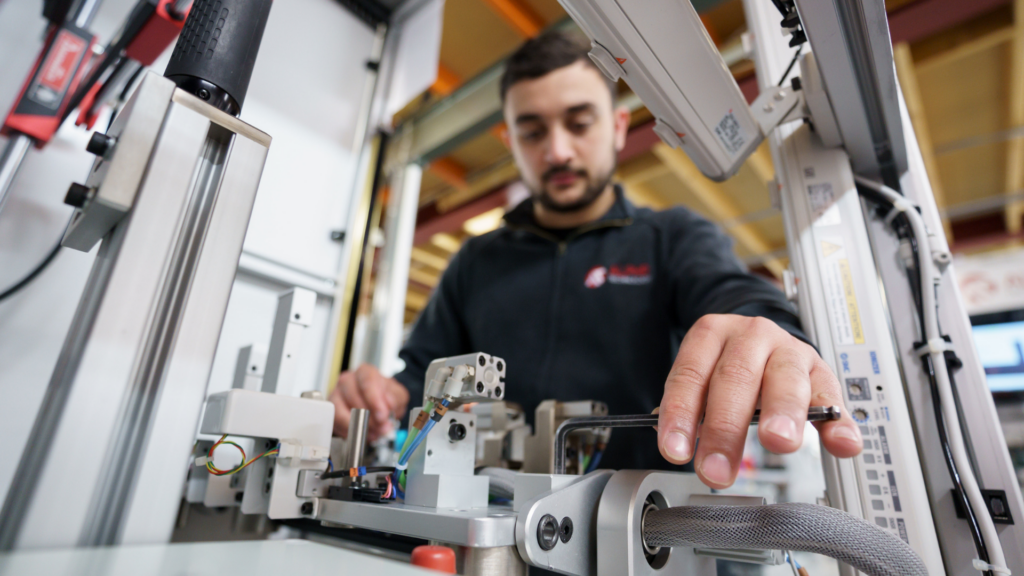
Changeovers are a fact of life in modern manufacturing, especially if you’re running multiple product variants through the same line. But how much time are you losing every time you have to stop everything, swap out tooling, and reset the line?
For some manufacturers, changeover time can eat up hours of valuable production every week. It’s not just inconvenient, it’s costly. Every minute spent reconfiguring a fixture or adjusting a test station is time you’re not building parts. That lost throughput hits delivery schedules, targets, and ultimately, your bottom line.
We work with customers to solve this exact issue. Through smart tooling design and automation, we help reduce or eliminate the downtime that comes with switching between variants, so you can build more, faster, with less disruption.
The Real Cost of Manual Changeovers
Manually changing tooling between product variants isn’t just slow, it introduces risk:
- Operators may install tooling incorrectly
- Fixtures may need adjustment or alignment
- Each change introduces variability
- Time is lost every time a product switch is needed
And when changeovers happen several times a day, the cumulative impact on throughput is significant.
If your takt time is stable but your line is idle for 30 minutes at a time during changeovers, you’re not getting full value from your automation. That’s where we come in.
Smarter Tooling Starts with Smarter Design
We believe in designing with flexibility from day one. Whether you’re producing a family of parts, handling batch builds, or need rapid response to customer variation, modular and adaptable tooling is key.
Our approach to tooling includes:
- Quick-release mechanical fixtures
- Self-aligning locating systems
- Auto-recognition for part detection and error-proofing
- Tooling that works across multiple variants with minimal rework
This helps reduce the need for full fixture swaps and shortens the setup window dramatically.
Manual vs Automatic Changeover
Not every application needs fully automatic changeover, but when speed and uptime are essential, automation delivers.
Manual Changeover:
- Lower initial investment
- Operator-dependent
- Can be inconsistent without strong training
- Still requires downtime for swapping, locking, and realigning
Automatic or Semi-Automatic Changeover (ALPHR approach):
- Higher speed, no operator intervention needed
- Greater repeatability and accuracy
- Supports “high-mix, low-volume” production without sacrificing throughput
- Easily integrates with automated test and assembly stations
Where possible, we automate changeovers through servo-controlled tooling, robotic loading systems, and software-driven part selection. That means the machine configures itself based on the variant being processed, with zero manual input required.
Designed for Flexibility from the Start
Whether you’re building automotive modules, electronic assemblies, or consumer products, our systems are designed to grow with you. Tooling is developed alongside the automation itself, not as an afterthought.
We work closely with your engineering team to understand:
- Your full product mix
- How frequently changeovers occur
- Which stations need flexibility
- What level of automation makes sense for your ROI
This leads to tooling that supports:
- Faster setup times
- Fewer errors during part change
- Reduced operator input
- Higher OEE across the board
Let’s Eliminate Changeover Downtime Together
If you’re currently losing hours each week to tooling swaps, or struggling to meet demand due to long reconfiguration windows, we’re here to help.
ALPHR brings together intelligent tooling, automation, and years of real-world engineering experience to create solutions that make changeovers fast, simple, and reliable.
Let’s design a smarter approach, so you spend more time building, and less time changing.