

There is a specific kind of dread that every production manager knows. It’s that moment at the very end of the line, maybe it’s Friday afternoon, when a batch of units fails the final check. You realise the mistake happened hours ago, or maybe even days ago, right at the start of the process.
With Tier 1 automotive tech like IVI systems, that isn’t just a “bad day.” It’s a disaster. These units are incredibly complex, the margins for error are tiny, and if you aren’t catching mistakes as they happen, you’re basically just gambling with your profit margins.
The “Zombie” Product Problem
We see this all the time: what we call the “zombie” product. It’s a unit that’s technically dead because of a tiny mistake early on, maybe a connector wasn’t seated quite right at Station 2, but it keeps moving through your factory like nothing is wrong.
It sits there soaking up electricity, taking up operator time, and having expensive components bolted onto it. By the time it hits the final test at Station 20 and you realise it’s a dud, you haven’t just lost a 50p connector. You’ve lost the screen, the casing, the high-end chips, and all the labour that went into it.
The real kicker? With modern, compact electronics, you often can’t even fix them anymore. Everything is so tightly integrated that trying to open it back up to fix that one connector usually just breaks something else. At that point, your only option is the scrap bin. It’s painful to watch.
Our Rule: No Faults Forward
So, how do we fix this? At ALPHR, we live by a pretty simple rule: No Faults Forward.
It’s exactly what it sounds like. We don’t wait until the end to see if things went well. We bake the inspection right into the assembly itself. Using things like smart vision systems and instant electrical checks, the line basically “polices” itself. If a step isn’t 100% perfect, the product doesn’t move. Period.
It changes the whole vibe of the production line. Instead of a mad scramble at the end of the day to see what’s salvageable, you have the peace of mind that if a product is moving, it’s right. Catching a fault in a millisecond means you can fix it right then and there, before the unit is sealed and the cost of the error spirals out of control.
Seeing the Whole Picture
But it’s not just about stopping the line; it’s about understanding why it stopped. We use Industry 4.0 tech to give you what I like to call a “birds-eye view” of your quality.
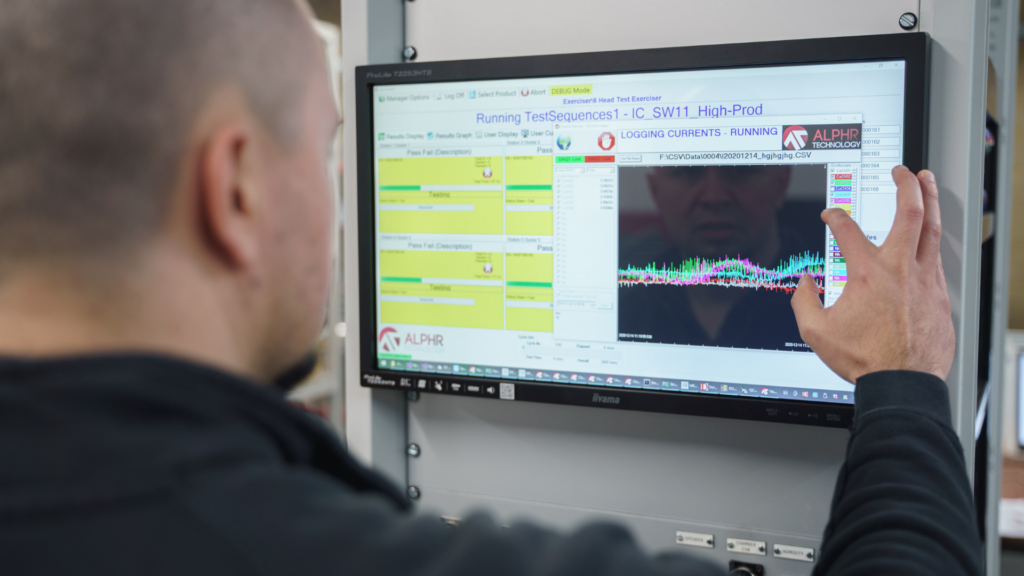
Imagine being able to pull up any single unit and seeing exactly how much torque was applied to every single screw, or looking at a high-res photo of a solder joint from three hours ago. This kind of data is a game-changer because it lets you see patterns. If a tool is starting to drift, you’ll see it in the data and fix it before you start making scrap.
We recently did this for an IVI project where we took a messy, fragmented testing process and condensed it into just three smart stations. The footprint was smaller, it needed fewer people to run it, and the feedback loop was so tight that scrap rates plummeted.
It’s About Peace of Mind
At the end of the day, “good enough” just doesn’t cut it anymore. Car manufacturers expect perfection, and frankly, so do your customers.
When you work with us, you’re not just buying a piece of kit. You’re getting thirty years of experience in your corner. We don’t just automate your current headaches; we look at your process and help you design those problems out of existence.
We need to stop treating inspection like a “final exam” at the end of the line. It should be the heartbeat of the entire process. At ALPHR, we aren’t just building machines, we’re building the certainty that when a product leaves your floor, it’s a perfect reflection of your brand.
Let’s stop finding faults at the finish line. Let’s make sure they never get there in the first place.