

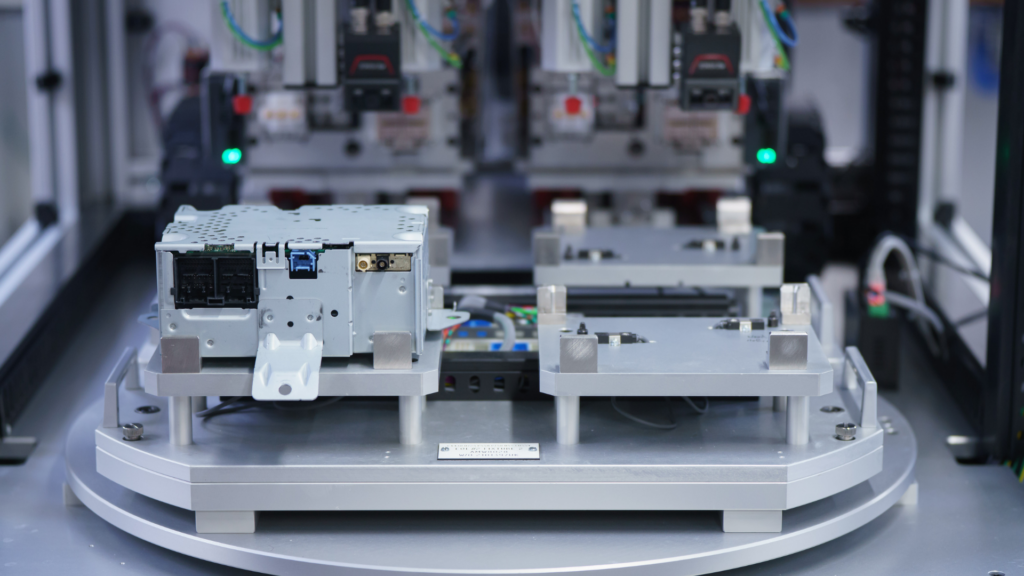
Picture this: your production line is humming, your automated assembly is working seamlessly, and your new product is finally ready for the final stage. All that is left is the End-of-Line (EoL) testing cell. You have built it in-house or patched it together with a generic supplier, assuming that as long as the components are plugged in, they will do their job.
But then, the red flags start popping up. False failures pull perfectly good products off the line. Worse, actual defects slip through straight to your customers. The root cause? A profound, often invisible gap in specialised test hardware expertise.
For Tier 1 automotive infotainment manufacturers and high-volume production facilities, EoL testing is the final gatekeeper of quality. Yet, companies that attempt to bypass a specialised systems integrator frequently fall foul of poorly integrated test hardware. They struggle to bridge the gap between basic functionality and true, optimised process control.
Let’s look at the three critical blind spots companies face when they do not leverage specialised testing expertise.
1. Do You Truly Understand What Hardware You Require?
On the surface, selecting testing hardware seems straightforward. You need to measure voltage, check communication protocols, or validate a digital display. However, in specialised environments like In-Vehicle Infotainment (IVI) manufacturing, the testing ecosystem is incredibly complex.
A generic understanding of hardware often leads to systems that are either over-engineered and wildly expensive, or under-engineered and incapable of handling real-world production speeds.
- The Integration Trap: Truly understanding hardware means knowing how various components interact under stress. Can your chosen instrumentation handle rapid protocol switching between CAN, CAN-FD, Bluetooth, and BroadR-Reach simultaneously?
- The Fragmented System: Without expertise, companies often end up with traditional, fragmented testing cells. This setup requires excessive floor space, drives up labour costs, and complicates maintenance.
An expert partner does not just buy hardware off the shelf. They apply an experience-led approach to consolidate complex specifications down to the exact, optimised system required, saving energy, minimising machine footprint, and reducing the total number of stations.
2. Do You Truly Understand How to Set Test Limits?
An instrument is only as reliable as the parameters assigned to it. Setting test limits isn’t just about reading a product datasheet and typing the minimum and maximum tolerances into your software.
If your limits are too tight, your system suffers from high false-failure rates, throwing your cycle times into chaos and wasting money on unnecessary rework. If they are too loose, faulty products pass through, triggering devastating warranty claims and product recalls downstream.
Setting mathematically and operationally sound test limits requires historical data, ambient environment consideration, and an innate understanding of machine capabilities. It means understanding the subtle variations in instrumentation tolerance versus product tolerance. Without an experienced guide, finding that “sweet spot” becomes a game of expensive trial and error.
3. Do You Truly Understand How to Get the Correct Data From the Integrated Hardware?
Integrating a piece of hardware is one thing; unlocking its data is another. Modern manufacturing thrives on digital transformation, Industry 4.0 enablers, and information transparency.
The Big Question: Is your EoL system just giving you a binary pass/fail result, or is it feeding actionable intelligence back into your operation?
When companies lack deep hardware comprehension, they fail to implement comprehensive Statistical Process Control (SPC) data packages. They miss out on the immense value of real-time traceability.
Without proper data extraction, you cannot track the who, what, where, and when of the manufacturing process. You lose the ability to capture gradual drift in machine performance, which prevents you from deploying predictive maintenance algorithms to stop unplanned downtime before it happens.
Shifting From Risk to Assurance
EoL testing should never be a guessing game. The financial and operational risks of poor hardware integration, ranging from operational inefficiency to damaged customer trust, are simply too high.
At ALPHR Technology, we have spent 30 years mastering the nuances of advanced automation and specialised test machines. We don’t just supply hardware; we take a consultative, end-to-end approach to design systems tailored perfectly to your operational realities.
Whether leveraging our “No Faults Forward” methodology to stop defects at the source or embedding custom software platforms that streamline global operations, we ensure your test cells deliver ultimate reliability.
Don’t let test hardware blind spots compromise your output. Let’s collaborate to build a robust, data-transparent, and future-proof roadmap to automation.