

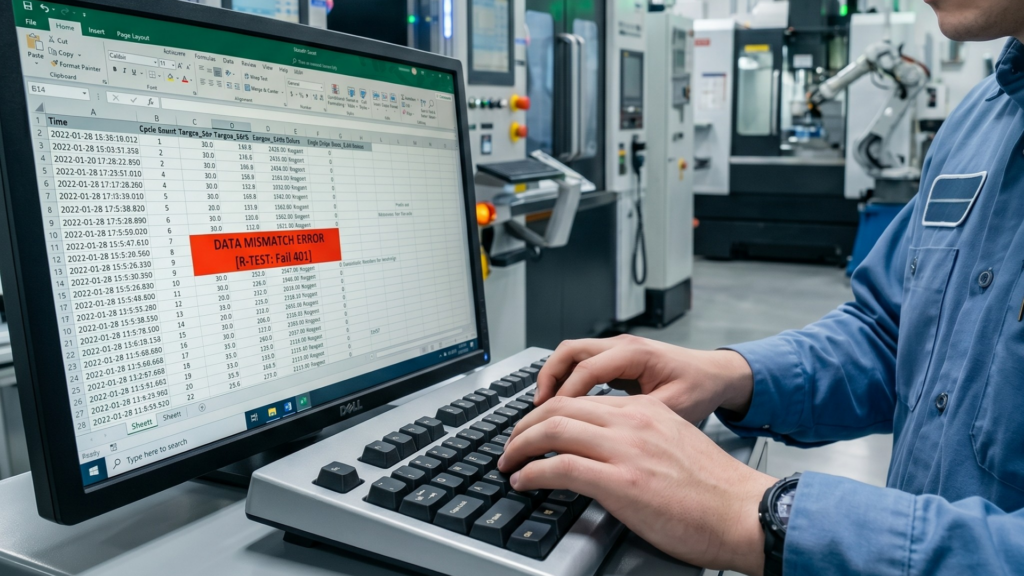
Imagine a state-of-the-art manufacturing facility. Millions of pounds have been invested in high-speed robotics, precision assembly tools, and advanced End-of-Line testing systems. The line is moving fast, and everything looks incredibly efficient. But if you walk over to the operator station, you see something that belongs in the last century: a clipboard, a pen, or a worker frantically typing test results into a spreadsheet.
In high-volume manufacturing environments, particularly within the Tier 1 automotive sector, data is just as essential as the physical product itself. Yet, a surprising number of companies still rely on manual data logging. It is a quiet bottleneck that exposes operations to severe quality, financial, and compliance risks.
When data collection relies on human intervention, it ceases to be a reliable asset and instead becomes a liability.
The Inevitability of the Human Factor
We have all been there. A long shift, a fast-moving production line, and a repetitive task. It is simply a matter of time before mistakes happen. Relying on manual entry means accepting that incorrect and incomplete information will be recorded.
A typo might seem harmless, but a transposed serial number or a missed decimal point in a test parameter can completely corrupt your quality records. If an operator gets distracted and forgets to log a specific test result, that product’s history is permanently compromised. In a world where precision is everything, guesswork or “near enough” data entry simply doesn’t cut it.
Falling Into the Traceability Trap
When quality issues inevitably arise downstream, the first thing a customer or regulatory body will demand is the product’s birth certificate. They want to know the who, what, where, and when of that specific unit’s journey through your factory.
If your data is trapped on paper logs or scattered across disconnected spreadsheets, establishing true traceability is nearly impossible. You cannot quickly isolate a faulty batch of components or prove that a specific test was passed successfully. This lack of automated data integration leaves you completely exposed to sweeping, expensive product recalls and devastating blows to your reputation, all because you cannot verify individual product integrity.
Missing the Strategic Big Picture
Data should not just be a historic record of what went right or wrong; it should be an active tool to improve your business. Manual data logging only provides a retrospective, fragmented view of your line.
Without automated, real-time data streaming into a centralised system, you miss the subtle warning signs of machine wear. You cannot track gradual drift in test limits, meaning you lose the ability to deploy predictive maintenance. Instead of fixing a machine during scheduled downtime, you are forced to react only when something breaks, throwing your cycle times into chaos.
Shifting From Paper Trails to Actionable Intelligence
The solution isn’t to tell your operators to type faster or pay closer attention. The solution is to remove the human element from data collection entirely through advanced automation.
At ALPHR Technology, we design automation systems featuring fully integrated data collection, custom SCADA software, and comprehensive traceability packages.
Our systems automatically capture and log every single data point at every stage of assembly and testing. No clipboards, no manual spreadsheets, and no room for error. The system ensures that a product cannot move to the next station unless its data is perfectly recorded and compliant.
Do not let outdated data habits hold back your manufacturing potential. Let’s collaborate to build a data-transparent, automated future for your facility.