

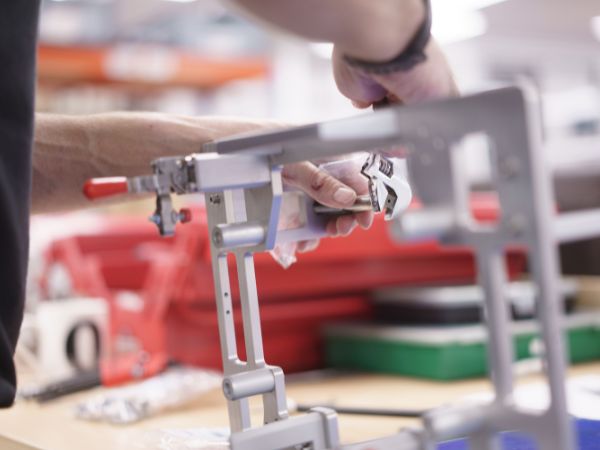
Every business wants to deliver high-quality products consistently, on time, and without surprises. But when manual operations form the backbone of production, keeping that promise can be harder than it should be.
Maybe your team is dealing with non-repeatable cycle times. Maybe you’re catching missing components during end-of-line inspection or worse, after shipping. Perhaps torque-critical operations rely too much on “feel,” and you’re seeing variation creep into your results. And let’s not forget the impact of operator availability: absences, high turnover, and the constant need for training can disrupt even the best-laid plans.
At ALPHR, we see these challenges all the time. The good news? Automation solves them, permanently.
The Problem with Manual Reliance
Manual processes bring flexibility, especially in early-stage production or prototyping. But when speed, volume, and repeatability matter, human variability becomes a liability.
Let’s look at what happens when you rely too heavily on manual operations:
- Cycle time inconsistencies: Human speed fluctuates, especially over long shifts. Even experienced operators work at different paces, which makes planning and scheduling difficult.
- Assembly errors and missing parts: It only takes one skipped step to compromise a product. Manual processes are prone to mistakes, especially when operators are fatigued or rushed.
- Misalignment and incorrect torque: Manual screwdriving can vary from person to person. Without automation, it’s hard to guarantee precise torque, every time.
- Dependency on staff availability: Absenteeism, shift changes, and staff turnover all affect productivity. You can’t plan for consistent output when your workforce is unpredictable.
These aren’t just small issues. They affect quality, safety, compliance, and customer satisfaction. And they’re costing you time and money.
How ALPHR Automation Solves the Problem
When we design an automation system at ALPHR, our focus is on stability, accuracy, and peace of mind. We remove the guesswork from your processes and replace it with reliability.
Here’s how:
- Consistent, repeatable cycle times
Our systems are engineered for precision. Whether it’s an automated assembly station, a torque-controlled screwdriver system, or a vision-based inspection process, every operation runs to a fixed cycle time, regardless of shift, operator, or location. - Built-in error detection
We integrate sensors, smart tooling, and vision systems to catch missing or misaligned components on the spot. With our “No Faults Forward” approach, products can’t move down the line until the previous step has been completed correctly. - Accurate torque every time
Torque variation is a common issue in manual screwing processes. Our automated screwdriving solutions apply precise, repeatable torque to specification and log the results. That means no more uncertainty, no rework, and no product recalls caused by loose or overtightened fasteners. - Resilience to workforce fluctuations
When your repetitive, labour-intensive processes are automated, you’re no longer reliant on full staffing to meet your output goals. That means fewer disruptions from sick days, fewer delays from onboarding new staff, and more freedom to redeploy your team to higher-value tasks.
Tailored to Fit, Designed to Scale
We know that no two production lines are the same. That’s why every ALPHR solution is designed in collaboration with your team. Whether you’re looking to automate a single workstation or rethink an entire assembly line, we work with you to identify the right approach.
We’ve delivered automation across a wide range of sectors, including automotive, electronics, industrial and consumer products. Our systems are:
- Modular and interchangeable, so you can adapt as your production changes
- Standardised across machines, simplifying training and maintenance
- Globally supported, with service teams and local support where you need it
The Outcome: Greater Control, Fewer Surprises
When manual operations are replaced with automated systems, the benefits are immediate:
- You get predictable, measurable output.
- Quality improves thanks to built-in checks and precision control.
- Staff can focus on meaningful, skilled tasks rather than repetitive, physical work.
- Training time drops. Downtime shrinks. And your customers get exactly what they expect.
So if manual processes are introducing risk and variability into your operations, now’s the time to explore what automation can do for you.
We don’t just automate, we innovate, integrate, and support. Let’s talk about building the kind of future where your production line runs with precision, consistency, and confidence.
Ready to reduce your reliance on manual operations? Get in touch with our team today and let’s start building a more reliable future.