
Manufacturing businesses around the world are hitting a wall. They’re trying to meet growing demand with shrinking teams. It’s not just about finding people anymore, it’s about finding the right people. Semi-skilled operators, the ones who keep production moving with hands-on tasks like assembly, inspection, and testing, are in short supply. And it’s not getting any easier.
Whether it’s due to an ageing workforce, fewer young people entering the trades, or the lingering effects of Brexit and global economic shifts, the pool of semi-skilled labour is getting smaller while the pressure to produce is getting bigger.
So what’s the solution when you can’t hire your way out of the problem?
Many manufacturers are finding their answer in automation.
The Skills Gap Problem
Let’s be honest: it’s hard to run a consistent, high-performing production line when you’re constantly having to train new staff or stretch a small team too thin. Many manufacturers are finding that even when they can find workers, they can’t keep them. Repetitive tasks, long hours, and a lack of career progression mean high turnover and constant recruitment costs.
It’s frustrating. And it’s expensive.
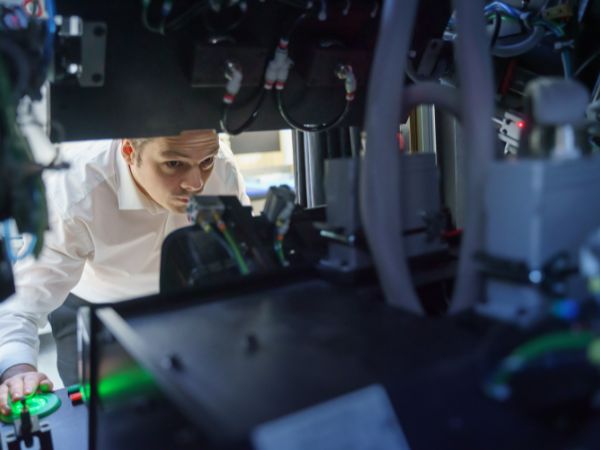
This is where automation steps in, not to replace humans entirely, but to handle the kind of tasks that humans are either hard to find for, or not really built to do for hours on end. Things like precise screwdriving, inspection, loading and unloading parts, or consistent torque application. The stuff that doesn’t require creativity, but absolutely does require accuracy and stamina.
Our automation systems are designed to take on exactly these kinds of jobs.
What Automation Brings to the Table
Let’s break it down. Here’s what happens when you introduce automation to help cover gaps in semi-skilled labour:
- Reliable Output, No Sick Days
Machines don’t call in sick. They don’t need breaks or holidays. Our solutions are built for consistency, running around the clock if needed. You get a steady, predictable output that doesn’t rely on shift coverage. - No More Training Headaches
Training new operators can be a constant drain on time and resources, especially when turnover is high. With our systems, you reduce the need for operator intervention altogether. And when you do need people involved, standardised software across machines means they only have to learn it once. - Better Quality, Fewer Mistakes
Humans make errors, especially on repetitive tasks. Fatigue, distractions, or unclear instructions can lead to misalignments, missed components, or faulty torque levels. Our automation brings precision to every task. Vision systems, torque feedback, and built-in checks all contribute to better first-time quality. - Scalable and Flexible
Worried about investing in automation that’ll be obsolete in two years? That’s not how we design systems. Our machines are modular and scalable, meaning you can start small and build up as needed. If your production requirements change, the machines can adapt with you.
So, What’s the Takeaway?
If you’re struggling to find or retain semi-skilled labour, you’re not alone. But you’re also not stuck.
Automation offers a way to build resilience into your operations, reduce your dependency on hard-to-find staff, and future-proof your production. And with a partner like ALPHR on your side, you won’t be navigating it alone.
Automation isn’t about replacing people. It’s about helping your team focus on higher-value work while machines handle the tasks they weren’t built to love. It’s about keeping your business moving when the labour market isn’t.
And most importantly, it’s about taking control of your future, not waiting for the skills shortage to fix itself.